

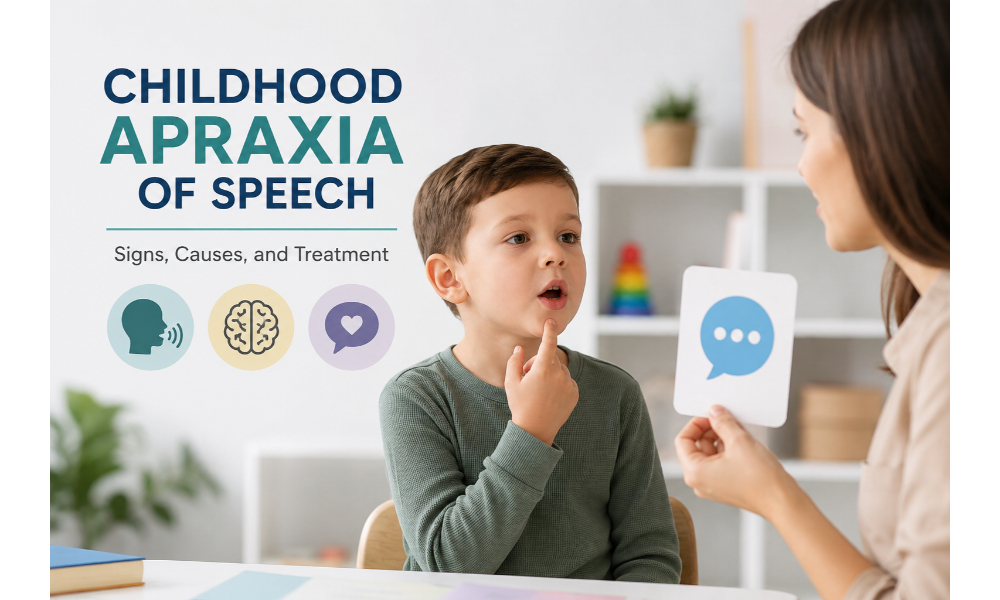
When a young child seems to know exactly what they want to say but can’t quite get the words out clearly, it can leave parents searching for answers. One possible cause is childhood apraxia of speech (CAS), a condition where the brain struggles to plan and carry out the precise movements speech requires. It’s a diagnosis that can sound intimidating at first, but understanding what’s actually going on is often the first step toward finding the right kind of help.
Key Takeaways
- CAS is rooted in motor planning, not physical weakness — a child’s speech muscles work fine on their own.
- The brain has trouble reliably directing the sequence of movements needed to form speech.
- Look for inconsistency, visible effort or searching for sounds, and struggles with multi-syllable words.
- Kids tend to do best when CAS is caught early and paired with regular, targeted speech therapy.
- A speech-language pathologist is the professional who can confirm a diagnosis and map out a treatment plan.
What Is Childhood Apraxia of Speech?
Childhood apraxia of speech describes a mismatch between what a child intends to say and their ability to physically produce it. The muscles involved in speaking aren’t the problem — it’s the brain’s signal-planning process that falls short, making it hard to line up the right movements, in the right order, at the right time. That’s different from disorders rooted in weakness or paralysis, where the muscles themselves aren’t functioning properly.
What Causes Apraxia of Speech in Children?
For most children with CAS, doctors and researchers can’t pinpoint an exact cause, which is why this form is often labeled idiopathic. A smaller number of cases appear alongside a known genetic syndrome or other neurological or developmental condition. Because a clear cause often can’t be identified for any one child, this can be one of the more frustrating aspects for families trying to make sense of the diagnosis.
What Are the Signs and Symptoms of Childhood Apraxia of Speech?
The way CAS shows up tends to shift as a child grows and their speech develops. Below is a general sense of what tends to stand out at different ages — though no two children with CAS present in exactly the same way.
| Age Group | What Parents Might Notice |
|---|---|
| Babies and toddlers | Little to no babbling, a small range of sounds, and first words arriving later than expected |
| Preschoolers | Sounds that change from one attempt to the next, trouble stringing together longer words, visible searching or “groping” movements of the lips and tongue |
| School-age children | Speech that sounds choppy or oddly stressed, and strangers having a hard time understanding them |
How Is Childhood Apraxia of Speech Diagnosed?
A speech-language pathologist (SLP) is the professional trained to identify CAS, typically through hands-on assessment of how a child produces sounds, moves their mouth, and communicates overall. Since several speech and language conditions can look similar on the surface, the SLP pays close attention to how consistent — or inconsistent — a child’s errors are, and works to rule out other explanations before landing on a CAS diagnosis.
How Is Childhood Apraxia of Speech Different From Other Speech Disorders?
It’s easy to mix CAS up with other communication challenges, but a few things set it apart. A child with a straightforward articulation disorder tends to mispronounce the same sounds the same way each time; with CAS, that same word might come out differently on separate attempts. CAS also isn’t a language delay — vocabulary and grammar aren’t the core issue here; it’s specifically about the physical planning behind speech.
What Treatment Options Are Available for Childhood Apraxia of Speech?
- Speech therapy built specifically around motor planning, tailored to the individual child
- A higher frequency of sessions than some other speech disorders typically require, since repetition drives progress
- Cues that engage multiple senses — visual, touch-based, or rhythmic — to reinforce correct movement patterns
- Parents practicing consistently at home, reinforcing what happens in therapy sessions
- Alternative communication supports, when useful, to help a child communicate while their speech continues developing
How Can Parents Support a Child With Apraxia of Speech?
- Keep up with home practice between sessions, guided by what the SLP recommends
- Notice and celebrate incremental wins — progress with CAS is often slow and steady rather than sudden
- Give your child space and time to get words out instead of finishing sentences for them
- Maintain an open line of communication with the SLP and any teachers involved in your child’s care
- Look into parent communities or support groups — connecting with others navigating the same thing can help
Frequently Asked Questions
At what age can apraxia of speech be diagnosed? Diagnosis often happens between ages 2 and 3, though it may come earlier for more pronounced cases or later when the signs are more subtle.
Is childhood apraxia of speech the same as autism? No — they’re separate diagnoses. Some children happen to have both, but a CAS diagnosis doesn’t imply autism, and vice versa.
Can children outgrow apraxia of speech? It’s not something children typically grow out of without intervention. Most need structured speech therapy to see meaningful improvement, and many go on to communicate well with consistent support.
How often should a child with CAS attend speech therapy? Shorter, more frequent sessions each week tend to work better than infrequent longer ones, since consistent repetition helps reinforce motor planning skills.
Is apraxia of speech caused by anything the parents did? No. It’s a neurological condition, and nothing about how a child was raised causes or contributes to CAS.
A childhood apraxia of speech diagnosis can feel like a lot to take in, but it isn’t a dead end — early intervention and steady, specialized speech therapy help many children build clear, confident communication over time. If your child’s speech development has you concerned, a speech-language pathologist is the right place to start.
