

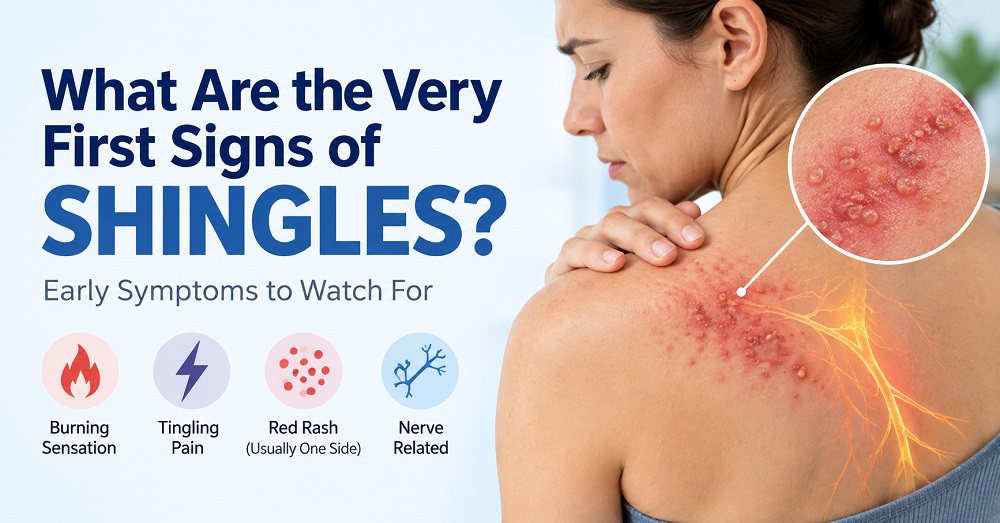
Shingles rarely announces itself with a rash right away. In most cases, the very first clues show up days before any blisters appear, and they can easily be mistaken for a pulled muscle, a bug bite, or even a heart or kidney issue. Understanding these early warning signs matters because starting antiviral treatment within 72 hours of the rash appearing gives you the best chance of a shorter, milder illness. This guide walks through what shingles is, the earliest symptoms to watch for, who is most at risk, and when it’s time to call a healthcare provider.
Key Takeaways
- The first sign of shingles is usually pain, burning, tingling, or numbness on one side of the body — often a day or more before any rash shows up.
- Shingles is caused by the varicella-zoster virus, the same virus responsible for chickenpox, reactivating after lying dormant in the nerves for years.
- A red rash with fluid-filled blisters typically follows the early pain, forming a single stripe on one side of the torso, neck, or face.
- Anyone who has had chickenpox can develop shingles, but risk rises sharply after age 50 or with a weakened immune system.
- Prompt medical attention — especially if the rash is near an eye — can reduce the risk of complications such as long-lasting nerve pain.
What Causes Shingles in the First Place?
Shingles, also known as herpes zoster, is triggered by the varicella-zoster virus. If you had chickenpox as a child, that virus never fully leaves your body. Instead, it retreats into nerve tissue near your spinal cord and brain, where it can remain inactive for decades. For reasons researchers don’t fully understand — though a natural decline in immune defenses as people age is thought to play a large role — the virus can reactivate later in life. When it does, it travels back down a nerve pathway to the skin, producing the pain and rash associated with shingles.
Shingles isn’t considered life-threatening, but it can be intensely uncomfortable, and it’s part of the same herpes virus family that causes cold sores. Importantly, it is not the same virus responsible for genital herpes, even though it shares a name family with other herpes viruses.
What Is the Very First Symptom People Notice?
Pain almost always comes first. Before any visible rash, many people feel burning, tingling, itching, or a deep ache confined to a small patch of skin on just one side of the body. This sensation can be sharp enough to be mistaken for a heart, lung, or kidney problem, depending on where it occurs on the torso. Some people also notice heightened sensitivity to touch in the area — even light contact with clothing can feel painful.
This early phase, sometimes called the prodrome, can last anywhere from one to five days before the rash appears. In a smaller number of cases, people experience the nerve pain without ever developing a visible rash at all, which can make early shingles especially tricky to identify.
What Other Early Symptoms Might Show Up?
Alongside the localized pain, some people experience symptoms that feel more like a general viral illness, including:
- Low-grade fever
- Headache
- Fatigue
- Sensitivity to light
These symptoms don’t affect everyone, and their presence or absence doesn’t necessarily predict how severe the rash phase will be. Still, if you notice one-sided pain combined with any of these symptoms, it’s worth paying close attention over the following few days.
How Does the Shingles Rash Develop After the Early Signs?
Once the rash appears — typically a few days after the initial pain — it tends to follow a predictable pattern:
- A red rash forms in the same area where the pain started.
- Fluid-filled blisters develop within the rash.
- The blisters break open and begin to crust over, usually within seven to ten days.
- The crusts gradually clear, often within two to four weeks.
The rash almost always stays confined to one side of the body, most commonly forming a band or stripe that wraps around one side of the torso. It can also appear around one eye or on one side of the neck or face, which requires prompt medical evaluation because of the risk to vision.
Where on the Body Does Shingles Usually Appear?
| Common Location | Typical Presentation | Notable Concern |
| Torso (chest, back, abdomen) | Single stripe wrapping around one side | Most common location; can mimic heart or lung pain |
| Around one eye (ophthalmic shingles) | Rash on forehead, eyelid, or around the eye | Risk of permanent eye damage if untreated |
| Neck or face | Blisters on one side of the neck or jawline | May affect nearby nerves |
| Scalp | Rash within the hairline on one side | Can be mistaken for a skin condition |
| Buttocks or limbs | Less common, still one-sided | Sometimes confused with contact dermatitis |
Who Is Most Likely to Develop Shingles?
Anyone who has had chickenpox — which includes most adults in the United States who grew up before the routine childhood chickenpox vaccine became widely available — carries the dormant virus and could potentially develop shingles. Certain factors raise the risk further:
- Risk increases notably after age 50, and people over 60 are more likely to experience severe complications.
- Weakened immunity. Conditions such as HIV/AIDS or cancer can lower the body’s ability to keep the virus dormant.
- Cancer treatments. Chemotherapy and radiation can reduce resistance to the virus.
- Certain medications. Long-term steroid use and drugs that prevent organ transplant rejection can increase susceptibility.
Is Shingles Contagious During the Early Stage?
A person with shingles cannot pass shingles itself to another person. However, the varicella-zoster virus inside the blisters can spread to someone who has never had chickenpox or the chickenpox vaccine — and in that person, it would cause chickenpox, not shingles. This is why it’s important to avoid direct contact with the rash, especially around pregnant women, newborns, and anyone with a weakened immune system, until the blisters have fully crusted over. During the early pain-only phase, before blisters form, a person is not considered contagious.
When Should You Contact a Healthcare Provider?
Reach out to a healthcare provider as soon as you suspect shingles, particularly if:
- The pain or rash is near an eye, since delayed treatment can lead to permanent vision problems.
- You are 50 or older, which raises the risk of complications.
- You or a family member has a weakened immune system.
- The rash is widespread, unusually painful, or accompanied by high fever.
Early evaluation matters because antiviral medications work best when started promptly after the rash appears — waiting too long reduces their effectiveness.
Can Shingles Be Prevented?
The Shingrix vaccine is recommended for adults age 50 and older, regardless of whether they’ve previously had shingles, and for people 19 and older with weakened immune systems. It’s given as two doses spaced two to six months apart. While the vaccine doesn’t guarantee you’ll never develop shingles, it significantly lowers the risk of the disease and of its most common complication, postherpetic neuralgia — nerve pain that can persist long after the rash has cleared.
Frequently Asked Questions
Can you have shingles pain without ever seeing a rash?
Yes. Some people experience the characteristic burning or stabbing nerve pain of shingles without ever developing visible blisters, which can make diagnosis more difficult.
How long does the early pain last before the rash shows up?
The prodrome phase, when pain, tingling, or itching occurs without any visible rash, typically lasts one to five days.
Is shingles the same as genital herpes?
No. Both belong to the herpes virus family, but shingles is caused by the varicella-zoster virus, while genital herpes is caused by a different virus (herpes simplex) and is sexually transmitted.
Can you get shingles more than once?
Yes, although it’s less common. Having shingles once does not guarantee lifelong immunity from a second episode.
Does stress trigger shingles?
Researchers believe factors that lower immune function, potentially including significant stress, illness, or aging, may play a role in viral reactivation, though the exact triggers vary from person to person.
This article is for general educational purposes and is not a substitute for professional medical advice. Always consult a licensed healthcare provider for diagnosis and treatment.
