

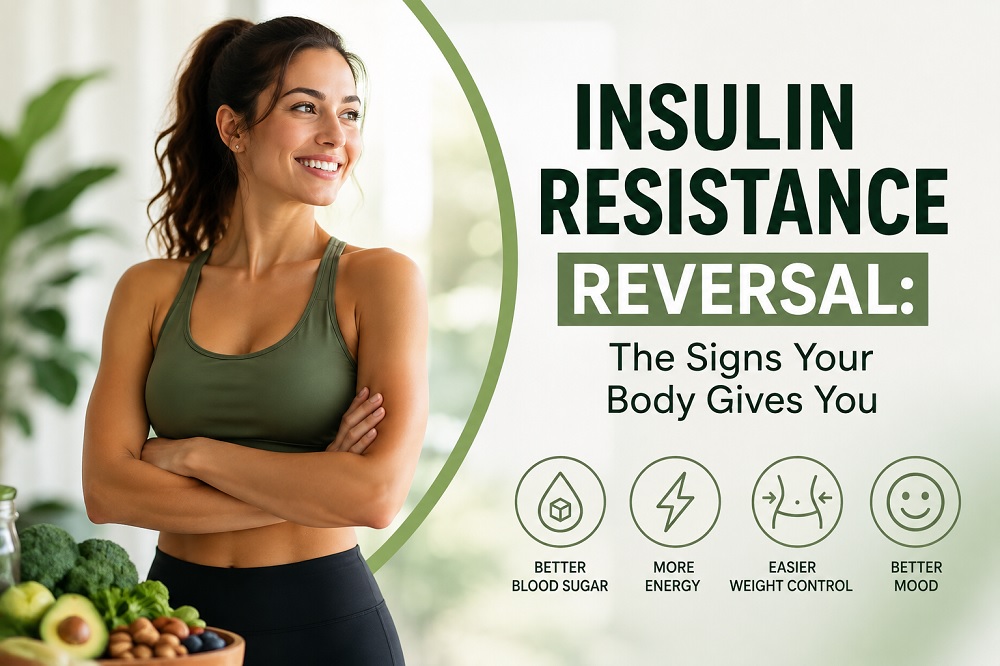
Insulin resistance doesn’t flip from “present” to “gone” overnight — it reverses in stages, and your body gives you signals along the way. Some of those signals you can feel day to day, others you can only confirm with a blood test. Here’s what your body actually tells you as reversal happens, what people commonly get wrong while tracking it, and how to confirm progress with confidence.
Signs at a Glance
| Sign | How to Confirm It |
| Fasting blood sugar trending down | Fasting glucose test |
| Belly fat shrinking first | Waist measurement |
| More stable energy through the day | Self-tracked / symptom log |
| Feeling full longer after meals | Self-tracked / symptom log |
| Skin tags and dark patches fading | Visual / photo comparison |
| Triglycerides down, HDL up | Lipid panel |
| Fewer sugar and carb cravings | Self-tracked / symptom log |
| A1C trending down | A1C blood test |
| Better sleep quality | Self-tracked / sleep tracker |
| Faster recovery after carb-heavy meals | Self-tracked / symptom log |
What Is Insulin Resistance?
Insulin resistance is a condition where your cells stop responding well to insulin, so your pancreas has to pump out more of it to keep blood sugar in a normal range. Left unmanaged, it’s a major driver of prediabetes, type 2 diabetes, and weight gain that concentrates around the belly. The encouraging part: unlike some metabolic conditions, insulin resistance is often reversible with consistent changes to diet, movement, sleep, and stress.
1. Your Fasting Blood Sugar Is Trending Down
A steady drop in fasting glucose readings is one of the clearest signs your cells are responding to insulin again. A healthy fasting range is generally 70–99 mg/dL. If your numbers have been sliding from the 100s into that range over weeks or months, your insulin sensitivity is genuinely improving — not just fluctuating day to day.
2. Belly Fat Is Shrinking First
Visceral fat — the fat around your organs — is one of the biggest contributors to insulin resistance, and it’s often the first place the body releases fat as insulin sensitivity improves. If your waist measurement is dropping even when the scale barely moves, that’s a meaningful sign, arguably more meaningful than total weight loss.
3. Your Energy Feels More Stable Through the Day
No more crashing at 3 p.m. That’s the short version. When cells absorb glucose efficiently instead of leaving it stuck in the bloodstream, energy stops swinging between spikes and crashes. People often notice this before any lab work confirms it.
4. You Feel Satisfied After Meals, Not Starving an Hour Later
Lasting fullness after eating is a sign your blood sugar isn’t crashing post-meal. Insulin resistance often causes a rapid glucose spike followed by an equally rapid drop, which the brain reads as hunger. As sensitivity improves, that rebound hunger fades.
5. Skin Changes Start to Fade
Darkening skin patches (acanthosis nigricans) around the neck, armpits, or knuckles, and skin tags, are both linked to high circulating insulin. As insulin levels normalize, these markers can visibly lighten or shrink over several months — though this happens more slowly than internal markers like blood sugar.
6. Your Triglycerides Drop and HDL Rises
A healthier lipid panel is a strong indirect signal. High triglycerides paired with low HDL (“good” cholesterol) is a classic insulin resistance pattern. When that ratio starts correcting itself on a follow-up blood panel, it usually means your liver is processing sugar and fat more efficiently.
7. Sugar and Carb Cravings Get Quieter
Cravings often ease once blood sugar stops swinging wildly. Constant sugar cravings are frequently a symptom of glucose crashes, not just habit or willpower. When those crashes become less frequent, the cravings that came with them tend to follow.
8. Your A1C Is Moving in the Right Direction
A1C reflects average blood sugar over roughly three months, so it’s one of the most reliable ways to confirm reversal is real and not temporary. A drop from, say, 6.1% toward 5.6% or below over two consecutive tests is a solid, lab-confirmed sign of improvement.
9. Sleep Quality Improves
Better sleep and improving insulin sensitivity often move together. Poor sleep raises cortisol and blood sugar, which worsens insulin resistance, and insulin resistance itself can disrupt deep sleep — so when one improves, people frequently notice the other does too.
10. You Recover Faster After Carb-Heavy Meals
A birthday dinner or a plate of pasta no longer wrecks the rest of your day. Faster physical recovery after higher-carb meals — less bloating, less fatigue, less brain fog — suggests your body is clearing glucose from the blood more efficiently than it used to.
Common Mistakes People Make While Tracking Progress
- Judging progress by the scale alone — muscle gain and fat loss can offset each other in total weight.
- Stopping prescribed medication early because symptoms improved, without a doctor’s guidance.
- Expecting lab numbers to shift in days rather than the realistic 3–6 month window most markers need.
- Ignoring sleep and stress while focusing only on food, even though both directly affect insulin levels.
- Not retesting blood work at all, and relying purely on how they feel to gauge improvement.
A Real-Life Example
Consider someone diagnosed with prediabetes at a fasting glucose of 112 mg/dL. Over six months, they walk daily, cut back on refined carbs, and prioritize seven hours of sleep. By month three, afternoon energy crashes disappear and cravings fade. By month six, a follow-up test shows fasting glucose at 96 mg/dL and A1C down from 5.9% to 5.5%. None of the changes were dramatic on their own — the shift showed up in the combination, tracked over time rather than expected overnight.
Frequently Asked Questions
How long does it take to reverse insulin resistance?
Most people see early signs — steadier energy, fewer cravings — within 4 to 8 weeks. Lab-confirmed markers like A1C and fasting glucose typically take 3 to 6 months of consistent habits to shift meaningfully.
Can insulin resistance be fully reversed?
For many people, especially those in the prediabetes range, yes — through sustained changes in diet, physical activity, sleep, and weight. For others, it can be significantly improved even if not entirely eliminated, particularly with genetic or long-standing factors involved.
What foods help reverse insulin resistance?
Fiber-rich vegetables, lean protein, healthy fats, and minimally processed carbohydrates support better blood sugar control. Reducing refined sugar and ultra-processed foods tends to matter more than any single “superfood.”
Does exercise reverse insulin resistance faster than diet?
They work best together. Exercise, especially strength training and brisk walking, improves how muscles absorb glucose almost immediately, while dietary changes affect insulin levels over a slightly longer timeframe.
Can you reverse insulin resistance without losing weight?
Some improvement is possible through exercise, sleep, and diet quality alone, but for most people carrying excess weight, even a modest loss of 5–7% of body weight meaningfully improves insulin sensitivity.
How do I know for sure my insulin resistance is improving?
Track it with actual lab work — fasting glucose, A1C, and a lipid panel — every 3 months, rather than relying on symptoms alone. Symptoms are a useful early signal, but blood tests confirm what’s really happening.
